A spooky kid-friendly ghost story!
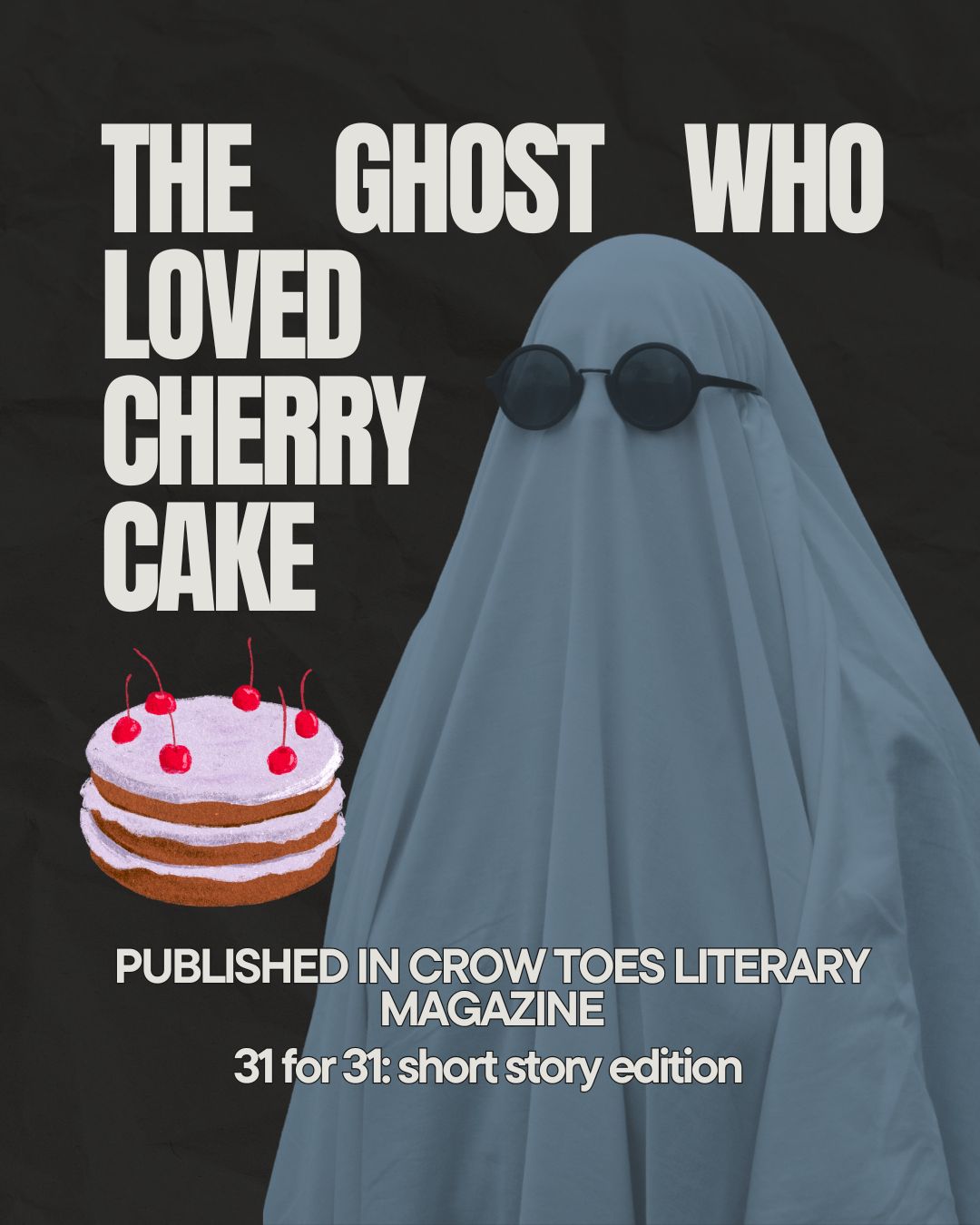
The Ghost Who Loved Cherry Cake is a simple ghost story with a neat twist involving snacks. Why does this particular ghost like cherry cake? You’ll have to read the story to find out, but I can tell you that this idea came from being postpartum and having my sense of smell still completely out-of-whack. At the time, I was also reading about how hauntings and especially alien abduction stories can involve distorted smells (often amonia and cinnamon). That sounded so gross, but one smell that sounded ideal to me during that time period was cherry.
And cake.
And especially cherry cake.
So this particular ghost was born.
I also wrote this as a children’s story. The main character is younger and the issues she’s tackling in the story are very kid-centric ideas. Her parents are getting a divorce; they’re having a last vacation as a nuclear family unit; and it’s fun and exciting, yet, of course, things are still weird. The adult world is hidden from her, and so, she seeks solace in the kid-world and supernatural elements of this location. The ghost of this vacation house, and the ever-present cake, is what gets her through this eerie time period.
The ghost is a good ghost–and so, this story ended up being utterly perfect for Crow Toes Quarterly, a literary magazine of the gothic for kids. I’m so sad this publication doesn’t exist anymore. When I got my contributor copy, I poured over it for hours. There were zany poems, monstrous and yet cute creatures, and even more photos and drawings that gave the magazine an element of an enchanted curio cabinet. The stories were quirky and weird and delightfully spooky, but not scary-scary. Perfect for the budding goth kid in us all.
Enjoy!
The Ghost Who Loved Cherry Cake
By Eve Morton
It took me about two weeks staying at the summer home my parents’ rented in the Outer Banks to understand that we didn’t have a housekeeper. Rather, Abigail Swanson, with her blue dress and brown eyes that sometimes turned golden in the afternoon light, was a ghost. And she absolutely loved cherry cake.
Our first day arriving, we had been late. It was a time before GPS, a time when a mother’s role in long car trips was to hold the book of maps as if she was a witch with a grimoire and to cast the right lot for the road they were to take. Needless to say, my mother was not one for the occult, let alone for reading maps. My father was better at it, and so he’d tried to memorize the remaining route through the surface streets and small towns leading up to the coastline when we’d stopped for lunch at a rest stop. His speculations on the fastest and shortest area, however, only led us to go around in circles in a place called Duck before we finally pulled into the right stretch of highway dotted with candy-colored houses in which we were to stay for the month of July. I had already fallen asleep by then, somewhere around thinking that the third or fourth time we passed through Duck it would change to Goose, and we’d play a game.
“Come now,” my father said, scooping me out of the backseat of the car. “We’re here.”
He carried me under the house, not through it, towards the roaring sound of the ocean. The night was so black, the sand so lumpy under my father’s feet, that it felt as if I was still dreaming. When I saw Abigail, though I didn’t know her name then, she was only a pair of eyes in that darkness. Golden and half-hidden under the stilts that kept the house above ground. I didn’t know it then, either, but those skittles were there to keep the house from flooding, to make sure a storm did not drag out bodies of small children towards the ocean.
My father set me down as we reached wooden stairs built into a hillside. He held my hand and told me we had to see the ocean before bed.
“What’s that?” I gasped, seeing part of the sand move.
“Ghost crabs.”
“Oh.”
“Don’t worry,” he added. “There’s nothing to be afraid of here.”
“Even ghosts?”
“Even ghosts,” he confirmed.
“Not all ghosts are bad, anyway. Some just want to help.” A woman added that answer, the same woman belonging to those eyes I’d spotted before. She came out of the darkness, right beside me, and held my other hand as we walked towards the shoreline. She said nothing else, but her fingers’ firm grasp on me was a reassurance after being lost for so long and scared by the natural life by the shoreline. My mother was nowhere to be seen, and my father seemed to sense that I was looking for her.
“Your mom is tired. It was a long drive.”
His words were short and curt, but like everything with my father, they seemed to hint at so much more. I took his explanation–mom is tired–as the reason this other person was here with us, a person who tucked me into bed after my father had left the room, and told me her name was Abigail.
“You can call me Abby. I used to live here. Now I just make sure it’s nice for everyone. What do you want for breakfast in the morning?”
“Cake,” I said. It was my birthday the next day. All I could think about was cake.
“Silly goose,” she said. “That is not a breakfast food.”
I was so tired, the trip weighing on my eight-almost-nine-year-old body, that I didn’t bother to tell her my birthday was tomorrow. I only laughed at the goose remark; after so many ducks, finally a goose! Then I went to sleep.
In the morning, there was a cake on the counter. It was white frosted with red dots all around it. My mother sipped coffee from a cracked mug at the counter, and shook her head towards my father. He was hiding behind a newspaper, another chipped coffee mug in front of him.
“I saw another roach,” my mother said. “This place is filthy.”
“It’s the south,” he said. “It’s warm and so there are roaches. They’re just like spiders elsewhere. Normal. Don’t worry about it.”
Their conversation about bugs and cleanliness went on. I ignored it, but in the back of my mind, I’d log it away as yet another reason why Abigail was with us that month in the Outer Banks. My mother needed help with the cleaning, and my father wanted someone else to look after me. I always felt Abigail’s presence before she ever materialized, and so, I never truly saw my parents interact with her. It didn’t matter.
She appeared behind me that morning, wearing a blue dress and with a white apron over it. “It’s my birthday,” I told her.
“Well, happy birthday. I should have made a cake I knew you’d like, then!”
“What kind is this?” I pointed to the frosting that seemed impossibly thick. Even though it was only the morning, when the air was always cooler back home, it was still humid like the afternoon here. It would only get hotter and thicker as the weeks wore on. The frosting would not last long in this climate, and Abigail sensed this and pushed the cake towards me.
“What do you think? You can have a little bit now.”
I dragged my finger through the cake, the frosting stacking up against the pad of my finger like snow. Sweetness burst on my tongue when I held it to my mouth. “It’s like a sundae,” I said.
“It’s cherry. My favorite cake.” Her brown eyes became golden again. “What’s your favorite?”
It used to be chocolate. But all I could think at that moment was cherry, cherry, cherry. I reached for another dab of frosting when my mother cried out.
“Hey! Breakfast first,” she said.
“But Abigail–” I turned back to see that she was now gone. Probably cleaning, making my bed or doing laundry, or something else that my mother’s frequent headaches prevented her from doing.
My mother said nothing about Abigail. Only insisted that I eat some oatmeal before we went to the ocean that day. “And then, when you come back,” she said, smiling though it seemed to tire her, “you can have a birthday wish on your cake.”
I did as my mother asked. My father and I went to the ocean, which was much prettier now that it was daylight, and I walked with his hand in mine as I collected shells. Big ones, small ones, broken shards that sparkled in the light. “I want to make a necklace with these,” I told him. “Maybe Abigail will help.”
“Maybe,” he said. He, too, asked nothing further about Abigail. He looked off into the distance, glanced at his watch, and told me we were almost out of time. “We should head back to your cake.”
We did. Abigail waited behind the cake, the candles spelling out ten years–one bonus for good luck–on top of it. The frosting had been fixed. Since no one else mentioned her, I took Abigail’s presence to be obvious. As natural as the stilts that kept the house up from the floods and hurricane waters that sometimes cascaded up from the sand dunes. She remained in place as I blew out the candles, but it was only her smile that seemed genuine. My father’s was distracted and my mother was, as always, tired.
“What did you wish for?” my mother asked.
“You can’t tell,” Abigail said. “Or it won’t come true.”
I had wished for more and more time with her, an entire vacation with Abigail and I exploring the Outer Banks with one another. But I remained quiet, shaking my head to my mother. When my mother sliced open the cake, and it was red inside, she let out a gasp. “Oh. They messed up the order. It should have been chocolate. It should have been–“
“I love it,” I said. “It’s cherry.”
“It is. You sure?”
I nodded. My mother’s skeptical glance didn’t fade until I put a large hunk of the cake in my mouth. Sweetness burned against my tongue. Cherry. Something I’d never had before, something that I didn’t know existed until that trip. It was stunning, wonderful, a perfect birthday gift.
“Well, okay then. I guess you’ll get your wish.” My mother shrugged. She took a piece along with my father, but they didn’t finish theirs.
“Too sweet,” they later said. “You enjoy it. All for you.”
Abigail took their pieces into the kitchen, cleaned up the dishes, and then ate a big slice herself. I sat with her at the kitchen table, drawing on a piece of paper. “I hope you don’t mind sharing,” she said. “Cherry is my favorite.”
“Is it?”
She nodded, her dark eyes golden bright again. “The last time I was at this house, I had my little girl with me. Her name was Cherry. She sort of looked like you, except a little taller and with more freckles against her nose.” She touched my nose and I felt, for the first time ever since arriving in this hotter climate, a chill move through me. “She was a very pretty Cherry. My darling delight.”
“Where is she now?”
Abigail grew sad. She ran her finger along the frosting of the cake, though it was under a cover, and brought it to her lips. I didn’t question that she’d moved through plastic then; I only giggled at the deviousness of an adult flouting the rules.
“There was a hurricane here,” she said a moment later, all lightness of the moment gone. “A big storm came. Large waves crashed into the house. I thought we were safe. I was wrong. Cherry was swept out into the water.”
“The house wasn’t on stilts then?”
“No. That is something new here. That is a good thing. You will be safer than Cherry was.”
I didn’t know what to say, never having heard of much death, let alone a child’s death. I looked at the picture I was drawing, and it was the best thing I’d ever done. So I gave it to Abigail. It was of a sun with sunglasses shining down on a few kids from my school who I played with during recess time.
“Beautiful,” Abigail said. “Can you draw me a picture of Cherry?”
“I don’t know what she looks like,” I said, then remembered it was like me. So as Abigail watched, eerily silent–this was the only time I ever felt a ghostly presence from her–I drew myself. Then I added dots along my face, to transform me into Cherry. I gave it to Abigail with a smile. “Here you go.”
“Beautiful!” she praised again. “Stunning, stunning. It is my own gift. And on your birthday! Well, I’ll have to make you another cake. Do you want chocolate this time around?”
“No,” I said. “Cherry is good.”
For two weeks straight, there was always a piece of cherry cake for me in the morning on the counter to eat by the afternoon after I had swum in the ocean. I never saw Abigail make the cake or even frost it; it was just always there. My parents, still often arguing in the morning or speaking in hushed tones about something I would only realize was their divorce a month later, never mentioned the cakes aside from imploring me to not get crumbs everywhere.
“The roaches,” my mother chastised. “Don’t tempt them with more.”
“And don’t spoil your lunch,” my father might add. But even he, like my mother, soon forgot their own rules as they argued with one another. Each one probably assumed the other had made the cake for me, to keep me happy and amused during the vacation, to keep me fed and happy and a little spoiled on our last one as a true family.
Each afternoon, one parent would trade off an activity with me. My dad and I went swimming in the ocean again; my mother and I explored the dunes and then a fishing museum close by; my father took me out for a special dinner, all alone. When I asked him what Abigail was doing, he shook his head.
“Don’t know. Probably with your mother.”
“Is Abigail coming home with us?”
“No,” he said. “Probably for the best.”
“Right. She’d miss her daughter. She died here,” I added, and when my father still said nothing, only stared out the window of the restaurant at the dark clouds coming, I figured he was thinking about how she’d died in a storm.
“Don’t worry, dad,” I said. “The house is on stilts now. We’ll be safe.”
He nodded, but we still ate in a rush. When we arrived at home, my mother was on the porch, holding a book, but no longer reading. “Storm’s coming. We should leave.”
“It’s not hurricane season,” my father said, still shaking his head. “This doesn’t make sense. I don’t understand. We have the house for another month.”
“The storm’s coming in another day. Who cares about another month?”
I rushed past the two of them, speaking to one another in harsher and harsher tones, so much like the thunder underneath the clouds. I found Abigail in my room, packing my bags. She met my gaze and nodded with a firm smile. “Time for my second cherry to go before the water comes.”
“You’re not coming with us?”
“No, sweetheart. This is my house. I stay here.”
“It’s on stilts now,” I said. “You’ll be safe.”
“Yes, but you need to go with your parents.”
I surprised myself by screaming, “No, no, no!” and kicking my feet. I hadn’t had a temper tantrum–or a “fit” as my mother called them–in such a long time. I had genuinely begun to feel like a grown-up on this trip, with two separate worlds and a cherry cake always to myself. Now all I could do was cry and pout and not even let Abigail hug me to tell me everything was going to be all right.
“I’m not losing another little girl,” she said and left me with my bags in the bedroom. When she came back, I had stopped most of my crying. She handed me a thick wedge of the cherry cake, all that had remained in a plastic container. “Here. Take this for the road.”
“What will you eat?” I asked.
“I’m home. I don’t need food to remind me of it.”
Her words were so calm, so confident, I merely nodded. My parents were inside now, no longer fighting but their voices still tense from the storm and the sudden emergency set upon us all. The sky outside my window, once only a pale blue for two weeks straight, was grey and dark and ominous. The roar of the ocean was suddenly drowned out by a siren. A warning from the coast guard. Hurricane coming. Storm coming.
“Sweetheart,” my mother said, entering the room and pushing her body through Abigail’s specter in front of me. “Time to go.”
I gasped. It was the first time, the first true time, I understood what Abigail was. A ghost. Not our summer housekeeper, not my new best friend, not even a woman who loved cherry cake because it was her daughter’s name. These things were all still true, but they were also cloaked by the fact that she had died a long time ago, maybe with her daughter or another summer here, and she was a ghost.
“It’s okay, it’s okay,” my mother said, wrapping me in a hug. “We will be all right. But we have to go. Vacation’s over.”
I looked over my mother’s shoulder and watched as Abigail nodded. She blew me a kiss and pointed to the cake in my suitcase, which she’d closed now. My mother grabbed the suitcase when she let go of me, and tugged me out the door.
The last time I saw Abigail was as we left the house. My father was driving, my mother in the front seat with a book of maps that were all but useless in her lap, and I was in the back. It was only the early evening, but it was as black as the night we’d first arrived. I looked at the house where I’d had my ninth birthday and one of the best vacations ever. When Abigail appeared on the wrap-around porch on the second floor, I knew she was a ghost.
But it was hard to be afraid. I had the cherry cake in my suitcase. I had the good memories. And her touch, as ghostly and cold as it had been, still rushed through me and comforted me as my parents fought again.
Abigail waved as the rain fell in heavy drops over the house and pounded like bullets against the roof of our rented car. She faded as we drove away, as the waves chased the houses on stilts along the shore, and the storm scared away the remaining tourists onto the now crowded highway. As I finished the cake in a Motel 6 that night, with my parents still bickering about directions, I thought of Abigail again and again. Even as we pulled into our home, which would no longer be shared between my parents in a months’ time, I still thought of Abigail.
I still think of her now, anytime someone mentions the ocean, hurricanes, or the Outer Banks. It’s hard to think of her as a haunting, as that summer vacation as being anything but delightful and sweet as the cake she served. Ghosts to me have never meant something to be afraid of, something to avoid. Ghosts have always been the people who know you the best, because they have lived through the worst, and know that in the end, the sweetest words are always the best. And life, too, can be a piece of cake.
END
 Eve Morton