This is a story so clearly about my workplace.
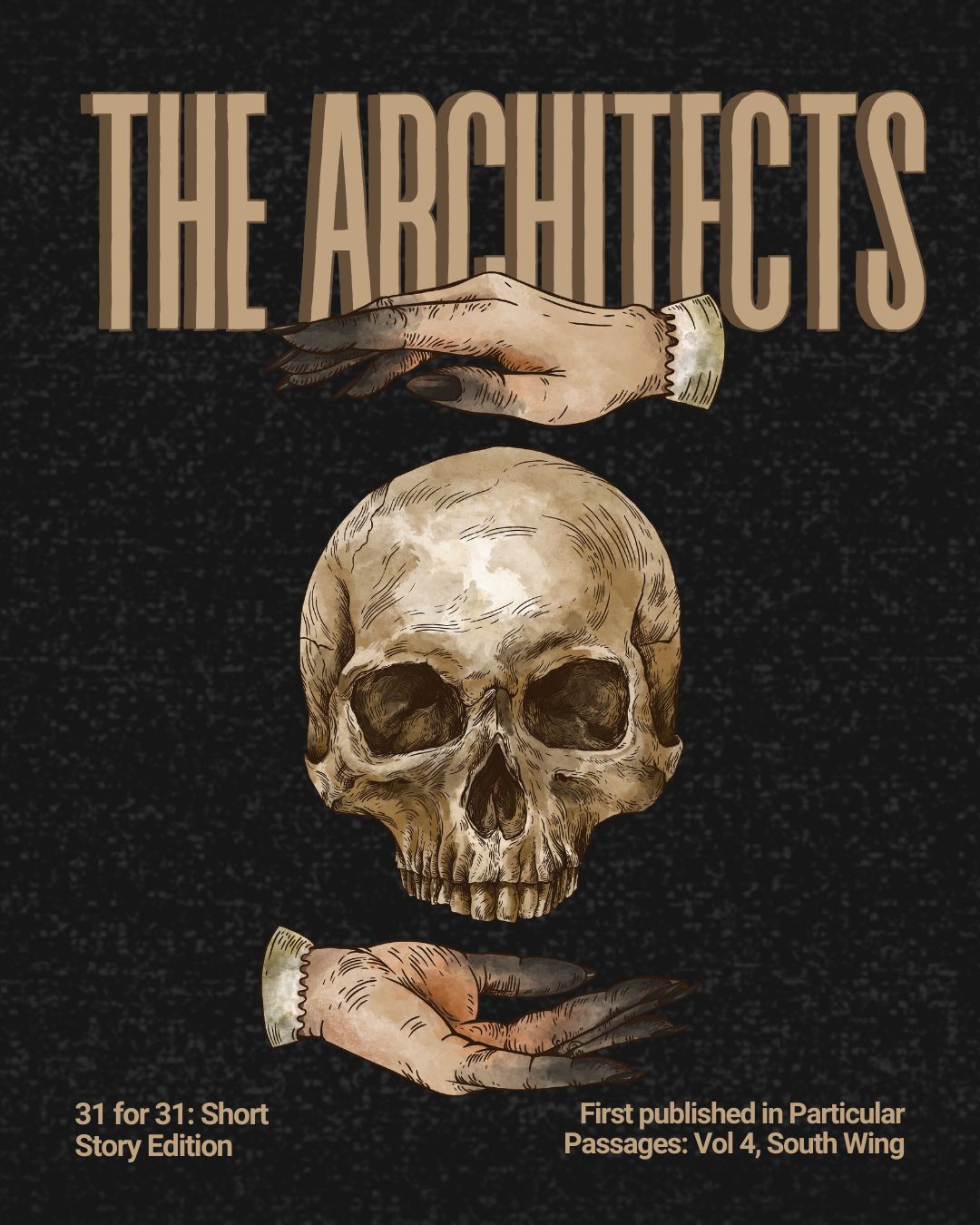
I teach at one of the leading Engineering schools in the world: the University of Waterloo. As a sessional, this often means I’m teaching those engineers English for a credit and I often get hostile audiences, ones who don’t really care about English Lit. That’s fine. But one of my favourite stories to tell them is about the structure of campus itself, and how at one point, there was an entire building built to keep people apart from one another, just like they, too, want to be kept apart from English Lit.
(Hagey Hall, one of the Arts buildings on campus, was built in a strange shape so that protests could not form; it was built after Kent State and this was seen as a positive feature. My old PhD supervisor is the source for this lore, since he was there during the actual construction process).
I’ve told this story about Hagey Hall so many times that it was inevitable that during my mat leave, when I wouldn’t have to walk its spooky halls, I would write a short story about a similar university that has similar problems with the shape (and capacity) of certain rooms.
So follow along with this weird and twisty tale.
The Architects
By Eve Morton
The first time I witnessed a room disappear on campus, I was a proctor for an exam.
When you’re in graduate school, you’ll take whatever work you can get. All students are desperate and I was no exception. When all the qualification you need to be a proctor is the necessary gender in order to escort students to the bathroom during the exam, hover outside to make sure they don’t cheat, and then take them back to the room, it’s an easy gig. Even when it is at seven in the morning, on the first day of winter, and in a part of the school I’d never seen before. Most of the other proctor spots needed men, since they had women profs. This was the only class, for a man named Tom North, who required a woman.
I snapped up the opportunity as soon as I could. I received a confirmation from the admin staff, and waited the week until the exam was set. I’d never met Tom North before, but since he was a staple of the old guard on campus, I’d seen his framed face on the wall of the school’s teacher’s lounge. He was a Big Deal back in the day, but he’d since become a dinosaur. In the age of social media and Rate My Professor, he would have barely received tenure. Then again, they don’t do tenure anymore.
I took the bus on the designated morning while it was still dark. Frost dotted the campus lawns as I walked deeper and deeper into the hulking buildings as they shifted and changed from one generation of architecture to the next. When the campus first opened, there had only been the brick buildings, the yellow-painted welcome center at the front of the campus, and the expansive library. The brick buildings had now become the designated Arts area, where my office was in a basement. The welcome center stayed roughly the same, save for a few updates to plumbing, and the library was now in the center, rather than the far edge, of the campus itself. The rest of the campus had been added on in the last fifty years, thanks to the school’s graduates and reputation becoming more prominent for Math, Sciences, and Engineering. As I walked, the buildings seemed to evolve alongside me. They became sleeker and taller, filled with windows and elongated forms, until it felt as if I had wandered too far from the 1950s brutalism that marked my office into a sci-fi landscape.
I was amazed. I’d never needed to go beyond the library before. Even when I was on the top floor of that building, and could see the outstretched campus, I never looked too closely at the architecture. Only the foliage, and the Canadian geese that stayed here all winter long.
Though I was acting as a proctor for an Arts class–Milton and his Contemporaries, according to the course calendar–exam season demanded bigger rooms, and so, better buildings were used. I had thought I would be ushered into the gym, but the room I needed to go to was in a building called M2. It was for Maths and Sciences. I located it on the edge of the campus, almost a twenty minute walk from where my own office was, and I arrived with barely ten minutes to spare. I hurried through the glass doors, warming instantly, and walked past large fossils and rock specimens from the local mines encased in class. I wanted to stay and linger, examine what seemed to be a hidden museum inside a university campus, but I was more concerned about making a good impression on Tom North.
I located the stairs and headed to the second floor where the exam was. I stepped out and realized it was the third floor. I doubled back into the stairwell, but there was no other door than the one I’d stepped into. Only two twists of the stairs.
The second floor was gone. Or at least, I had no access to it in the stairwell.
I found the elevator on the ground level. I now only had five minutes until the exam began. In the elevator, I punched the #2 key easily. I stepped out a second later into an area of campus that looked like any other. There were tile floors that scuffed my shoes, thick wooden doors leading into various rooms, and a large foyer.
An empty foyer.
Even though it had been a long time since I’d written an exam myself, there were always early birds outside, hastily cramming until the last minute. Or late stragglers who wandered in from a bus, dazed and disoriented.
But there was no one here. Not even footprints or boot tracks from the limited snow outside. There was no evidence at all that anyone but me had been in the building all morning.
I walked down one of the two corridors that split off from the foyer. I compared the number of the room I’d been given for the exam against the doors around me. I walked in a semi-circle and came out the other side of the large foyer.
There was nothing. No room, and the only way there could have been a room with that number, would have been if the exam could take place here. In the foyer. From the way the stairs and the halls curved, it was the only way to make sense of anything.
“Hello?” I called out, thinking of nothing else to do.
No answer.
I started to panic then, believing this to be my error and my error alone. My phone had no signal in the thick walls, so I stepped out of the building–it probably wasn’t the right one anyway–and called the front desk in the English Department.
“Hello?” a woman named Margaret answered. “How can I help you?”
I explained to Margaret the situation. “I’m a proctor for Tom North, but I think I’m lost. I can’t find the room.” I gave her the number. I heard her click the keyboard on the other side. When she was silent a long time, I babbled about receiving a confirmation for the job, and that though I’d never met Professor North before, I didn’t want to leave him with a bad impression. “If I’m late, it’s one thing. But I don’t want to make it so his students suffer, either.”
More clicks. Soft breathing from the other side. “This is odd. Says the exam was supposed to be in the Arts department.” She listed a number close to my office.
“What? I was never told. I’ll head right over.”
“Then he cancelled it,” Margaret added, her voice thin. “I’m so sorry. I guess no one got around to telling you. It’s the end of the year, and–“
“Oh. Oh.” I let out a breath. It was a mistake. No one’s fault. When Margaret assured me that I’d still be paid for my time, all three hours the exam was supposed to go on, I really had nothing to be mad about.
“Again, we’re sorry,” Margaret said. “Enjoy your day–and your holidays!”
I spent the rest of the morning in the strange building, looking at the fossils and the rock specimens I’d never seen before. But soon would see, nearly every day, in time.
*
The second time a room disappeared on campus, I nearly missed it because it wasn’t a room at all. It was a hallway that suddenly disappeared, and nearly left me stranded in my office during a winter storm.
A year had passed since the incident with Tom North. I moved on from the preliminary stages of my PhD, passed the classes and the comprehensive exams, and was now in my writing mode. Tom North had retired shortly after the proctor mix-up, and I’d heard through the mailroom gossip circle that he’d died. Not uncommon for professors of his generation. It was one of the main issues–spoken about in hushed, polite tones, of course–that people in the department reminded me of when I selected Maurice Callahan as my own supervisor. He was of Tom North’s generation, had started the PhD department when he first began teaching at the university, and was already in his mid-seventies. He’d had no health problems so far, but that seemed to be a strike against him. It would only be a matter of time.
I liked Maury, though, as he wanted to be called. He was funny. He laughed at my jokes. And there was a certain allure to the fact that he was almost as old as the school itself. He’d watched the campus unfold into the strange monolith that it was now.
“It had a completely different reputation ten, twenty years ago,” he told me during one of our monthly supervisory meetings. “It was an Arts school, through and through. You know the sculpture that’s just outside Hubert Hall?”
I nodded. The sculpture was off a flat man, as if he’d been steamrolled, throwing a ball in the air.
“It’s not a ball. It’s a shot-put. It was supposed to be a symbol for the sports team–the flames–and a symbol for Prometheus stealing fire.”
“Supposed to?”
“Yes, well, I think he sort of loses his context now. The art may stay, but meanings change. And well, it feels like we’re strictly in the punishment stage of Prometheus’s life, getting our livers plucked out.”
I laughed. I could see–and sympathize with–his disdain for the lack of funding the Arts was now receiving. “That’s hindsight for you, I guess.”
“That’s the thing,” Maury said. “Prometheus means foresight. We should have seen this coming before, not after, our funding was gutted. Hindsight was Prometheus’s brother, Epimetheus.”
“I don’t know that story,” I said, cheeks blushing. I made a note to look it up, but Maury told it to me anyway.
“He was the twin of Prometheus, and together they were tasked with giving animals traits. But since Epimetheus lacks foresight like Prometheus, he didn’t give anything to man. He was a fool, in short, which then led his brother to steal fire and stand trial for that crime. Personally, I think we undervalue Epimetheus. He can be the fool, sure, but he’s also the kind one. There is no ulterior motive here. He’s pure materialism, which is to say, thought comes afterwards. He makes something. Then he tells us about it.” Maury laughed. “I think a lot of PhD students can benefit from that attitude. Not you, of course.” He gave me a sly smile. “But I see many students tell me what they’re going to write, and then never do it. Just write the damn thing, you know? Then you can steal fire somewhere else. Now, let’s get back to your project.”
It was only three days after that conversation when I became stuck in my office. The hallway that I’d taken to get there had simply disappeared. There were two main stairwells to gain entry to the basement of the building: one was the main entrance, flanked by glass doors and school colors, and then there was the back exit that was barely noticeable, especially in winter, when snow was piled close to the doorway. It was known as the “smoker’s exit” since those piles of snow often turned gray in no time with cigarette butts and ash.
I liked using the smoker’s doorway. It made coming and going to my office feel clandestine, and since students always seemed to recognize me on campus and want to discuss their grades, being covert was necessary. I’d taken that exit as an entrance like I always did, walked by the bathrooms and the information area, and then settled into my office, next to many other PhD offices. An hour, maybe two, had passed. When I was ready to leave, I wanted to use the bathroom.
But they were gone. The entire information center and its waiting room was gone. There was only a blank wall, nothing hanging on it, where it had once been.
“I don’t…” I didn’t finish my sentence because I heard it echo. I placed a hand against the wall that I swore had never been there. It was solid. I pressed my ear against it. I swore I could hear something–murmuring, chattering–but it could have been my own heartbeat. I tried to follow the wall, to see if it would lead me somewhere else, but it was truly a dead end. Just a wall where there had once been a way out.
I turned the other direction, in search of the elevator. That was the only other way I knew of getting to the front exit. My heart did not stop pounding in my chest until I stepped out on the first floor, saw the blazing sunlight through the glass doors, and touched them. They were real. They let me leave.
I was too spooked to go around back, where the smokers left their cigarettes, to check if that door was still there. By the time I did, a week and a half later, nothing had changed.
The hallway was back where it had been. There was a smoker’s exit again.
But a clear sign had now been posted in red, angry letters NO SMOKING WITHIN 9M OF THE BUILDING. The janitorial staff, and a handful of grad students, were now in obeisance of that law, and stood nine meters back. I wanted to go over and join them, take up smoking simply to ask if they had been there last week, and if so, did they get trapped outside, unable to get back in? When had the hallway come back? What the hell had happened?
But I didn’t say a thing to them.
I saw Maurice instead.
*
“Now that’s interesting,” he said, after I’d spilled the incident about the hallway and the previous one a year ago with Tom North’s nonexistent exam room. “You should write a story about that.”
“I don’t want to,” I said. Maurice often worked under the premise that nearly everyone obtaining an English Literature PhD wanted to be a writer in some way. He did when he was young, though, and some of the other grad students also harbored literary ambitions–but I just wanted to understand things. Including the strange campus. “I just want to know that I can trust the campus maps, and trust where I think I’m going.”
“You can trust the maps,” Maurice said. “Especially the online ones. They update more frequently.”
“So you’re telling me that the online map would have reflected that sudden change in my office? Even if it was only for an hour or a week?”
“I don’t know. I don’t use it myself.”
“How do you get around?” I asked him. He’d told me on several occasions that he walked everywhere, including to and from the campus since his house was merely a block away. It kept him young, he joked. But maybe it also kept him with working knowledge of a place that I was starting to realize I could never fully pin down or figure out.
“On foot,” he answered obviously.
“But how do you remember where to go?”
“I’ve been here a long time, remember. I was here when the Dean gave the order to build most of the newer parts of campus. I was even on some committees when they were electing to reshape some of this building, too.”
“They’ve renovated Hubert Hall?” I looked around the thick brick walls of his office, so much like mine in the basement. The architecture itself was so dense cell phones never worked. Even some of the computers that had been installed didn’t get wifi and had to rely on Ethernet cables. “Hard to tell.”
“I know, but they did. And it was a serious endeavor and expense, hence the committee. It was in the 1960s,” he began, getting somewhat of a dreamy quality to his voice. “I won’t bore you with too many details, because I could write a book about this myself.”
“Maybe you should.”
“Maybe. But I think it’s been done. Either way, this meeting was about the foyer. They didn’t want a large one for students to congregate inside. In effect, they wanted to avoid protesting. There was a lot of uproar about Kent State, with good reason, and so when I say that the staff didn’t want protestors, don’t think they were regressive. They merely wanted to save student lives. So they decided to not have a large foyer, and extend what they needed to do through many hallways instead.”
“Really? Like where my office is?”
“Yes. That’s why I thought it was interesting that a hallway disappeared. Almost like the school is fighting back, protesting itself.”
I didn’t want to believe him, yet I could feel it in my bones that he was right. “What about the other building?” I asked a moment later. “The one where Tom North’s exam should have happened, but didn’t? M2, Mathematics. That’s a newer building, right?”
“It is. But North–oh, he hated that area.”
“Hard not to,” I said then quickly added, “given the history between arts and sciences and funding. But it was really pretty. There were fossils there. It was nice.”
“Yes, I’ve seen those myself. The architect is a bit better than this brutalism. At least phones work.”
“Sometimes,” I added. “Not that morning with me.”
“Huh.” He shrugged, and then ran his hand over his beard. “From what I recall, though, the architect who designed those buildings was related to the first one who did Hubert Hall, version 1.0.”
“Including the hallways?”
“I think so. They were brothers?” Maury shook his head. “No, couldn’t have been with the generational difference, especially in styles. Must have been father and son, or something like that. I think I remember the surnames being similar. Potter or Pohle or something like that. So yeah, father and son.” When he noticed me take a note, he added with a wry smile, “be sure to double-check my information, of course. I’m not exactly as much of a library as I used to be.”
I told him I would. Then I remembered the library. “What about that?”
“What about the library? It’s been here as long as I can remember.”
“Right. Who built it? Was it the father or the son?”
“That I don’t know, but I would assume the father. It hasn’t been renovated, though, aside from the tech updates. So maybe it’s the only place on campus that will stay still.”
“Maybe.” I wrote down ‘Library’ and underlined it several times. Then, as easily and as quickly as we spoke about the campus, we moved onto my PhD research. My dissertation was almost complete, and when it was, my time at this school would be coming to an end.
*
The third time the campus changed shape for me, I was prepared.
I was teaching a class in the Environmental Sciences building. It was closer to the center of campus, having been one of the first buildings in the expansion of the early 1990s. Everyone on campus back then had welcomed the addition. It was the early days of environmental awareness at a popular cultural level; the legwork in critical Sciences had already been done by Rachel Carson’s Silent Spring in the 1960s, and so, having a building on an already liberal and progressive campus devoted to the green movement was easy to understand and push through budgetary approval.
It was also easy to make the building stunning. Filled with high glass windows and large, spacious foyers, there was clearly no fear of protestors here. Entirely one side of the foyer walls was covered in a make-shirt trellis, complete with waterfall that allowed whatever greenery on the trellis to bloom and grow and thrive. The staircase into the upper levels was open and allowed for complete viewing of the green wall. I loved looking at it up close–but those stairs gave me vertigo. I often took the elevators to my class on the third floor, or I took the back stairwell when there was a line-up for the elevator.
I was halfway through the spring semester when I noticed the contours of the building change. I took the stairwell to the third floor, but the doorway out read the second. I continued walking and added another flight, but came out at the fourth floor.
The third floor had disappeared.
I walked down to the building’s ground level and started again. The elevators took me to the third floor, but when I walked out, it was still the second. That was where all the offices, rather than classrooms, were so it was easy to recognize. I doubled back once again and stood in the foyer. Some of my students had already started to arrive, and seeing me, went over to say hello.
“Are you all right?” a girl named Deidre asked me. “You look a little pale, if you don’t mind me saying.”
I considered lying for a moment, saying I was sick, and cancelling the class. How could I get to the class if the floor didn’t seem to exist? But when I saw Shawn, another student of mine, take the free-floating stairs next to the green wall, and make it to the third floor without doubling back, I realized there was only one way to the room.
“I’m fine,” I told Deidre. “But will you walk with me? I don’t quite like heights.”
Deidre was one of those eager to please students, so she took me up on my offer without protest. I made a mental note to give her 100 for participation for the next six weeks, until this class was done, since I knew I’d be relying on her far more. We found the room together, as easy as pie, except that the nagging feeling of the floor disappearing again bothered me.
We were in the middle of Marilyn Robinson’s Gilead this week, a text about an absent father writing to his son who will not remember him, and it felt as if the campus was mocking me in some way. Or aligning in the best way possible. From one of the large glass windows in the room, as I read off the passage I wanted my students to analyze, I saw the library’s ornate edifice and tall, imposing structure.
The library, where nothing seemed to change. The library, where from its top-most floor, all of the campus could be visible.
I quickly finished my class, with ten minutes to spare, and dismissed them. Deidre stayed behind. “Do you need help getting down the stairs?”
“No thank you,” I told her. “Going down is always easier than going up.”
She nodded, and gave a silent promise to be there the next week. I knew it would not be a problem, though. The campus was going to right itself, even if I had to be the mediator between father and son.
*
My visits to the library, at first, were uneventful. I went to the top floor, studied the landscape, but still came back with all I’d seen before: a lot of nice greenery, a campus split in two, and those ever-present geese. I wandered through the stacks, trying to find all I could about the architects who built the campus, but only came up with names, the thinnest of biographies, and blueprints. Frederick and Philip Pohle. Father and son, much like Maury had said, and with different design schools influencing their work.
When Frederick had died, Philip took over his business, but left many clients unhappy with his attempts to become the Canadian Frank Lloyd Wright. He didn’t have enough ambition to take on that kind of legacy, however, or the proper work ethic, so most of his designs remained on paper. The only places that came to fruition were ones he inherited from his father: the campus extension, a renovated downtown building that I had never liked, and a hospital a town over that had since been torn down. Philip had no children of his own, and so the family business died with him.
I made photocopies of all the blueprints I could find, giving special attention to the campus extensions. I figured I could take those, at the very least, to Maury who might be able to help me piece the mystery together–but I soon realized the maps fit over one another. Not as a mere expansion of the campus, but as another layer over top. I took the photocopies out of the tray and made sure that what I’d seen in a glimpse could truly fit. Once I found the library on the blueprints, and used it as the centering anchor it was, the campuses aligned. It was perfect. They weren’t added on in a spatial way, but stacked up in geological time.
“Like those fossils,” I said aloud. The library was so quiet my voice, though a whisper, seemed to be a roar. Everyone in the study carrels had on headphones, so no one noticed. But I tip-toed around like a mouse, suddenly afraid that the secret was out.
After asking a librarian for tracing paper, I went into a study area and laid out the maps on top of one another. I traced around them, wondering if I could see the way in which floors and hallways had disappeared on me. I could make the maps work in some instances, but not in others.
Baffled, I logged into some of the online accounts for the school’s student body and found a message board. A handful of people described the campus as the most difficult to navigate they’d ever come across. The room I needed seemed to disappear, one person wrote, peaking my attention. It sounds crazy, but that’s what happened. I didn’t find it until a week later.
I started to link together online reports with my own experiences. Soon enough, when I flipped over the blueprint I’d traced, so it was now a mirror image on top of the older campus, the coordinates began to make sense. Father and son had designed the exact same building, but always in opposition.
So how to make them stop feuding, even after death? I wondered about this for a long time. It was only as the semester wore on, and Maury began to get more persistent about my dissertation, that I remembered his words of foresight and hindsight.
Don’t be like Prometheus, he wrote to me in an email. You don’t want to be repeating this year over and over, even if it seems like fun. You gotta move on and finish that degree.
But what about hindsight? I asked him in return. What if I realize now that I like the campus, and want to stay?
He didn’t answer me for a couple days. In the interim, I’d found the sole place of unbalance in my maps of the father and son campus. While the Arts campus had its own figure of Prometheus with a shot-put/fireball, the Science side of campus did not have such a figure. Only a blank area, where someone had put a trash can and where squirrels and geese congregated.
We can talk about alternative plans at your next meeting, Maury wrote back. It’s usually better to teach at a different school. Shows depth. But if you really want to stay, we can figure out a way to make it work.
I will be teaching at a different school, I thought. I’d been stuck on the father’s side of campus until that proctor exam. Frederick Pohle may have wanted me to, like the olden ways of graduate school, leave and set about on my own–but his son Philip had other plans. He was a bit more dynamic and interesting, if only on paper. He just needed more ambition and work ethic, something I knew I had in droves. If he only had his own monument to hindsight, maybe his father could be proud.
Then, after that, maybe the fighting could stop.
*
When I met with Maury a week later, I told him of my progress. He didn’t seem that surprised that my dissertation, once about the genre known as the campus novel and the subsequent works of Don DeLillo, had now become about the father and son feud that seemed to stretch on for generations in the ever-shifting landscape.
“I told you,” he said after I’d explained it all, including the pitch to get another statue to keep the men happy, “you should be a writer.”
“Fine. Yes, sure, this is what I’ll write my dissertation about, and it will help me get a job here. On Philip’s campus, though. It’ll be different that way.”
Maury didn’t say anything for a long time. He picked up the maps I’d given him, and the notes, including my sketch for the matching statue of Epimetheus on the other side. He was a flattened monument like the previous one on the other side, only he held a hammer in his hand rather than a shot-put/flame.
“I wanted the hammer to symbolize materialism,” I told Maury in the silence. “The fact that thought here comes after form, after the hammer blow. And I–“
“It’ll take a lot of funding to get this to go through,” he said, cutting me off. It was not mean, only a fact.
“That’s fine. I can help. I don’t know how to fund beyond a bake sale, though.”
Maury smiled. “You gotta learn grant writing soon. It’ll be a great part of your service record. And if you can pull off this statue, especially as a Canadian historical site, while also writing your dissertation, well, then, you’ll be a shoe-in as a prof here.”
“Really?”
“Yes. Don’t expect tenure, though,” he added quickly. “No one gets that anymore.”
I didn’t want tenure. I just wanted to teach in that building with the fossils. I wanted to see a statue of a flattened man, holding a hammer like Epimetheus, and melding the work of father and son into one.
*
A year, then two, went by. My dissertation passed with few revisions and I turned it into a book about the father and son team. I applied for a job teaching Writing and Communication to the Science and Math students, and was accepted after three rounds of interviews. Not with tenure, of course, but with a three-year contract.
My office is now in the M2 building, and overlooks the statue of Epimetheus on the campus.
Though sometimes, when I walk the same stairs that lead to the second floor, it disappears, I now know how to get it back. I call out for father and son to behave, to develop some hindsight.
Then I take the elevator.
It all sorts itself out in the end.
When the campus is truly temperamental, and foresight or hindsight get us nowhere, then I cancel the class I need to teach entirely. I tell them to go to the library instead, because that’s where I’ll be. I make sure I am on the top floor, looking down on both time and space, and generations of a family history at once. I look out at all that I’ve inherited, all that I can claim as my own, with the right map to understand where to go next.
When a student shows up, which sometimes happens and sometimes not, I show them the statues of Prometheus and Epimetheus, and they learn, for at least an hour, how to stay in one place.
END
 Eve Morton